The topic of chatbots has become increasingly relevant in recent years as businesses look for ways to improve their customer support and engagement with their audience.
Chatbots, such as ChatGPT, use natural language processing and artificial intelligence technology to provide quick and accurate responses to customer inquiries, making them a valuable tool for businesses looking to improve the customer experience. However, content marketers can also use ChatGPT to generate AI-assisted content. Read more to learn how.
ChatGPT is surely the best
But its servers are put to the test
With so many users chatting
It’s no wonder they’re lagging
But they’ll fix it soon, no need to fret!
What is ChatGPT?
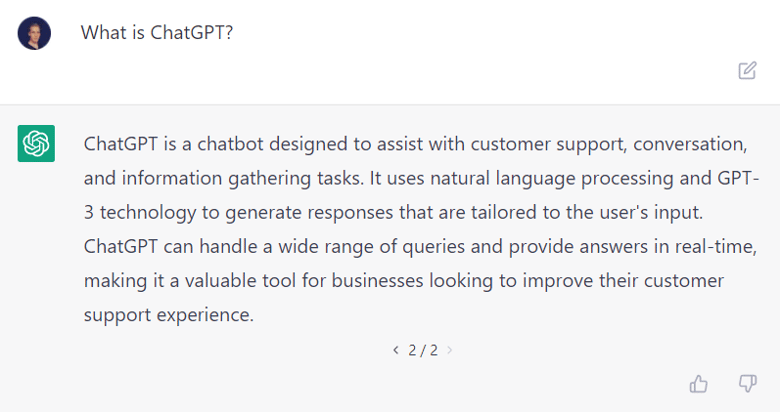
ChatGPT is a intelligence chatbot developed by OpenAI and designed to assist with customer support, conversation, and information gathering tasks. It uses natural language processing and GPT-3 technology to generate responses that are tailored to the user’s input. ChatGPT can handle a wide range of queries and provide answers in real-time, making it a valuable tool for businesses looking to improve their customer support experience. ChatGPT was initially released in 30th November
Here’s how ChatGPT looks like (you may recognize the text):
ChatGPT can be used for a variety of customer support and conversation tasks, such as answering frequently asked questions, providing product information, and helping customers navigate a website or mobile app. It can also be used for information gathering, such as gathering user feedback or conducting surveys. Additionally, ChatGPT can be used for conversation tasks, such as providing conversation prompts or engaging in social media conversations. One of the ways ChatGPT can be used is content marketing.
Top benefits of ChatGPT for businesses
- Fast response time: Quick and accurate responses to customer inquiries, freeing up time for human customer support agents to focus on more complex or unique tasks.
- Content generation: The ability to generate engaging and relevant content based on specific input and user interests, increasing the likelihood of engagement and driving traffic to a business’s website or social media channels.
- Research and content curation: The ability to research and curate content from various sources, helping businesses create a consistent and valuable content marketing strategy.
- Customer engagement: The ability to assist with engaging with customers on social media or providing conversation prompts on a website’s blog or forum, improving a business’s online presence and customer engagement.
How companies can use ChatGPT for content marketing?
Companies can use ChatGPT for content marketing by utilizing its natural language processing and GPT-3 technology to generate engaging and relevant content for their target audience.
ChatGPT can help businesses create content that is tailored to the specific interests and needs of their audience, making it more likely to grab their attention and drive engagement.
Additionally, ChatGPT can assist with researching and curating content from various sources, helping businesses create a consistent and valuable content marketing strategy.
As a content marketer, it is important to understand how ChatGPT can assist with creating and curating content. ChatGPT’s natural language processing and GPT-3 technology allows it to generate engaging and relevant content based on specific input and user interests. This can help content marketers create content that is tailored to their target audience, boosting the chances of engagement and directing traffic to their website or social media channels.

What are the pitfalls of ChatGPT for content marketing?
One potential pitfall of ChatGPT for content marketing is that it relies on artificial intelligence and natural language processing technology, which can sometimes result in content that is not engaging or relevant to the target audience.
It is important for businesses to carefully review and edit the content generated by ChatGPT to ensure it aligns with their brand voice and messaging.
Additionally, ChatGPT may not be able to handle complex or unique content requests, requiring human intervention to generate high-quality content.
Lastly, ChatGPT may not be able to fully replicate the creativity and emotional intelligence of a human content creator, which may be a disadvantage for some businesses.
How to use ChatGPT?
- Sign up for an account on the ChatGPT website or download the app from the App Store or Google Play.
- Configure your ChatGPT settings, including the language, response time, and tone of the chatbot.
- Integrate ChatGPT into your website’s chat function or social media channels.
- Input specific prompts or queries to ChatGPT and let it generate a response.
- Review and edit the response as needed to ensure accuracy and relevance.
- Repeat the process as needed to assist with customer inquiries, content creation, and information gathering tasks.
As a content marketer, your skills to ask good questions, provide domain knowledge, and review created text become extremely useful.
What is the role of content marketers in the future?
The role of content marketers in the future will likely focus on leveraging artificial intelligence and natural language processing technology to generate engaging and relevant content for their target audience. Content marketers will need to understand and utilize these technologies to create content that is tailored to the specific interests and needs of their audience.
Additionally, content marketers will need to be skilled at researching and curating content from various sources, helping businesses create a consistent and valuable content marketing strategy. As AI technology continues to evolve, the role of content marketers will likely continue to shift towards leveraging these technologies to improve the efficiency and effectiveness of content creation and distribution.
Final thoughts

AI-assisted content marketing and copy-writing is a powerful tool that allows businesses to quickly and accurately generate engaging and relevant content based on specific input and user interests. This helps businesses create content that is tailored to their target audience, increasing the likelihood of engagement and driving traffic to their website or social media channels.
Additionally, AI technology can assist with researching and curating content from various sources, helping businesses create a consistent and valuable content marketing strategy. AI-assisted copy-writing can also improve the efficiency and effectiveness of content creation, allowing businesses to produce high-quality content in less time.
Overall, AI-assisted content marketing and copy-writing is a valuable tool for businesses looking to improve their online presence and customer engagement.
You can find ChatGPT on https://chat.openai.com/chat and http://openai.com/blog/chatgpt and learn more about it there.
Join Main Group of ChatGPT on Facebook and WhatsApp Below!
ChatGPT – FB Group
ChatGPT – WhatsApp
Is ChatGPT a ‘virus’ ?
At the time, Altman described OpenAI’s potential in language that sounded outlandish to some. Altman said, for example, that the opportunity with artificial general intelligence — machine intelligence that can solve problems as well as a human.
Is so great that if OpenAI managed to crack it, the outfit could “maybe capture the light cone of all future value in the universe.” He said that the company was “going to have to not release research” because it was so powerful.
Asked if OpenAI was guilty of fear-mongering — Musk has repeatedly called all organizations developing AI to be regulated — Altman talked about the dangers of not thinking about “societal consequences” when “you’re building something on an exponential curve.”
The audience laughed at various points of the conversation, not certain how seriously to take Altman. No one is laughing now, however. While machines are not yet as intelligent as people, the tech that OpenAI has since released is taking many aback (including Musk), with some critics fearful that it could be our undoing, especially with more sophisticated tech reportedly coming soon.
Indeed, though heavy users insist it’s not so smart, the ChatGPT model that OpenAI made available to the general public last week is so capable of answering questions like a person that professionals across a range of industries are trying to process the implications. Educators, for example, wonder how they’ll be able to distinguish original writing from the algorithmic-ally generated essays they are bound to receive — and that can evade anti-plagiarism software.
Paul Kedrosky isn’t an educator per se. He’s an economist, venture capitalist and MIT fellow who calls himself a “frustrated normal with a penchant for thinking about risks and unintended consequences in complex systems.”
But he is among those who are suddenly worried about our collective future, tweeting yesterday: “Shame on OpenAI for launching this pocket nuclear bomb without restrictions into an unprepared society.” Wrote Kedrosky, “I obviously feel ChatGPT (and its ilk) should be withdrawn immediately. And, if ever re-introduced, only with tight restrictions.”
We talked with him yesterday about some of his concerns, and why he thinks OpenAI is driving what he believes is the “most disruptive change the U.S. economy has seen in 100 years,” and not in a good way.
Our chat has been edited for length and clarity.
Musk left OpenAI partly over disagreements about the company’s development, he said in 2019, and he has been talking about AI as an existential threat for a long time.
But people carped that he didn’t know what he’s talking about. Now we’re confronting this powerful tech and it’s not clear who steps in to address it.
I think it’s going to start out in a bunch of places at once, most of which will look really clumsy, and people will [then] sneer because that’s what technologists do. But too bad, because we’ve walked ourselves into this by creating something with such confidentiality.
So in the same way that the FTC demanded that people running blogs years ago [make clear they] have affiliate links and make money from them, I think at a trivial level, people are going to be forced to make disclosures that ‘We wrote none of this. This is all machine generated.’ [Editor’s note: OpenAI says it’s working on a way to “watermark” AI-generated content, along with other “provenance techniques.”]
I also think we’re going to see new energy for the ongoing lawsuit against Microsoft and OpenAI over copyright infringement in the context of our in-training, machine learning algorithms. I think there’s going to be a broader DMCA issue here with respect to this service.
And I think there’s the potential for a [massive] lawsuit and settlement eventually with respect to the consequences of the services, which, you know, will probably take too long and not help enough people, but I don’t see how we don’t end up in [this place] with respect to these technologies.